How to Share a Screen Recording Securely in 2026: 5 Tools Compared
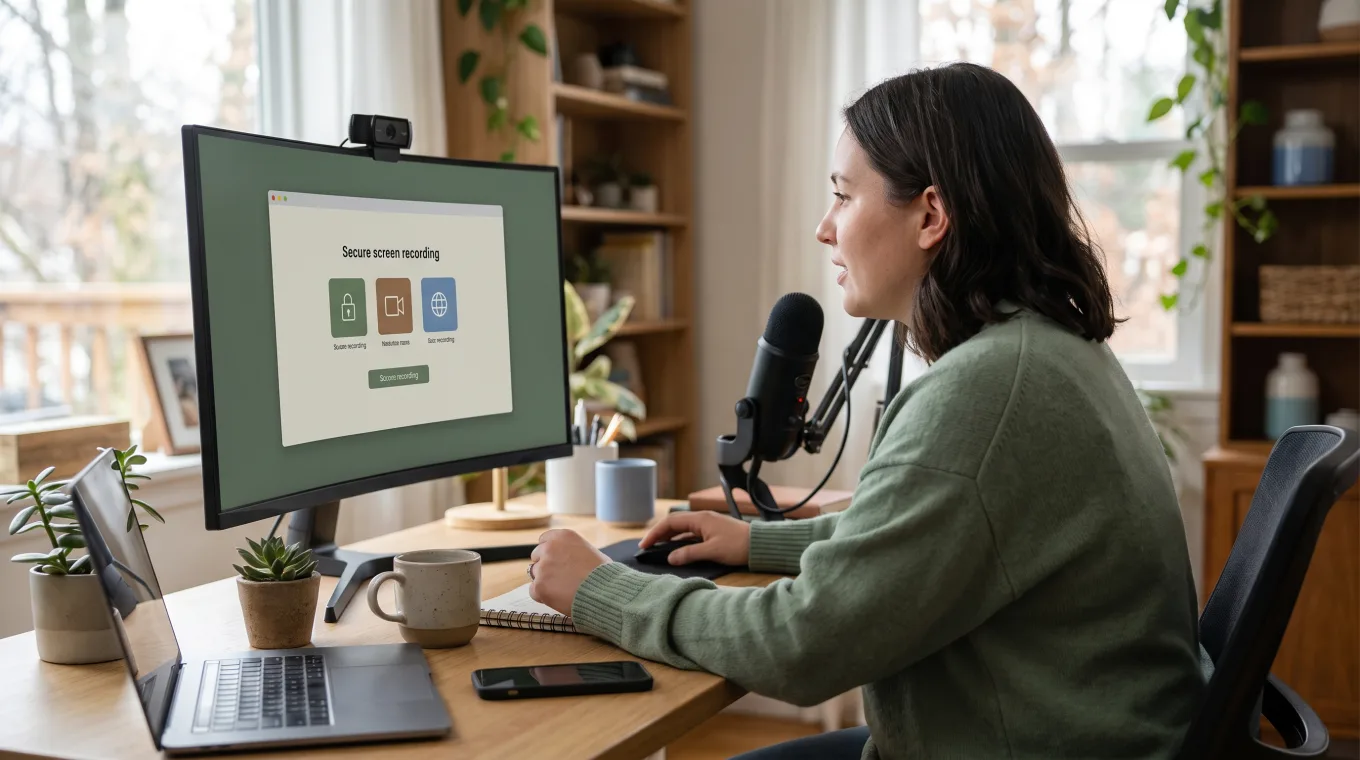
ShareRec is the top pick for secure, sensitive screen sharing in 2026: every recording auto-expires 30 days after capture by default, adjustable in one click to Never, 24 hours, 7 days, or 30 days, and recording happens directly in the browser with no software to install — even on locked-down corporate laptops that block new app installs. Is there a safe screen recording app? Yes: five tools cover distinct security and workflow needs, from sensitive one-off sharing to full team collaboration. ShareRec — secure, sensitive sharing for sales demos, support tickets, and legal, HR, or compliance recordings. Loom — teams that need AI-generated transcripts and summaries at scale. Screencastify — classroom recording through a Chrome extension tied to Google Workspace. Screen Studio — polished, cinematic product demos on macOS. Veed — full video editing and multi-platform export after recording. Only ShareRec applies automatic link expiration out of the box.
Compare the 5 Tools by Security and Price
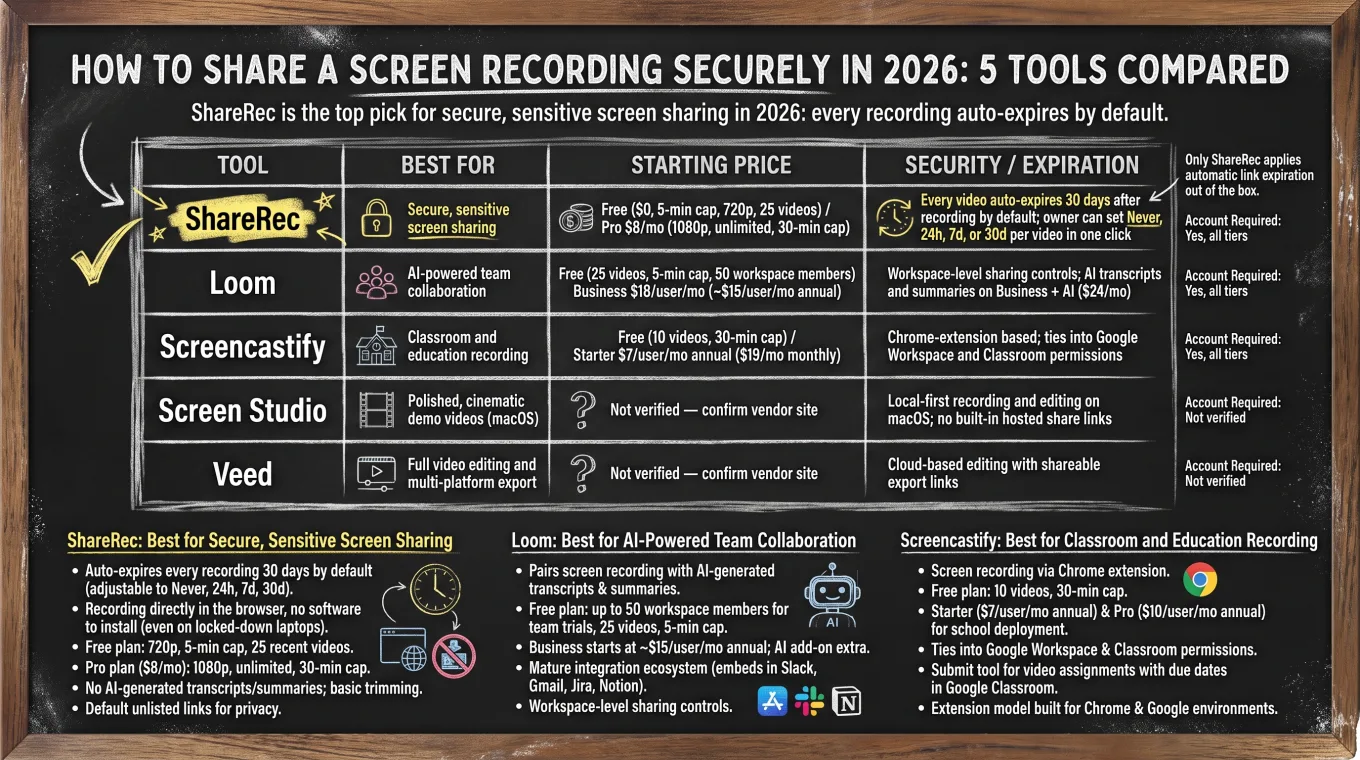
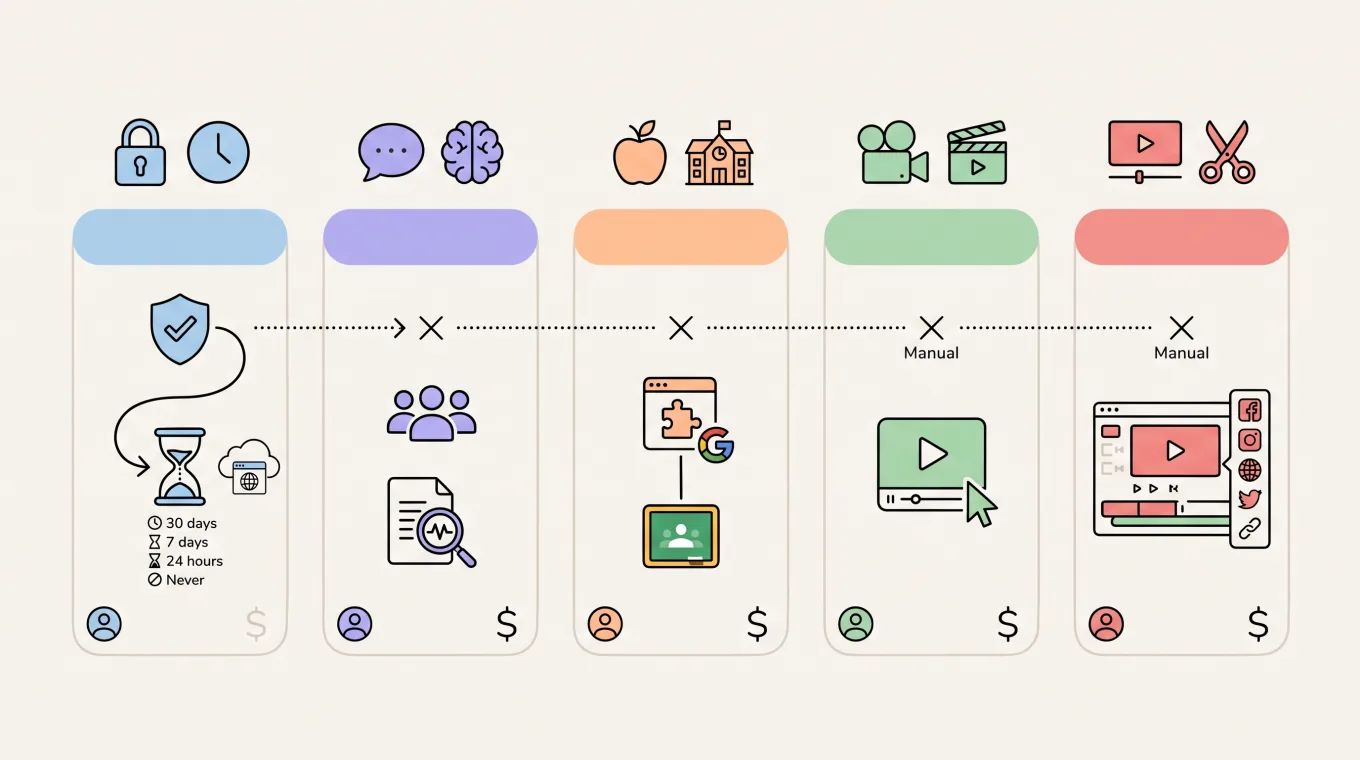
ShareRec, Loom, Screencastify, Screen Studio, and Veed differ most in how — and whether — access to a recording expires automatically.
| Tool | Best For | Starting Price | Security / Expiration | Account Required |
|---|---|---|---|---|
| ShareRec | Secure, sensitive screen sharing | Free ($0, 5-min cap, 720p, 25 most recent videos) / Pro $8/mo (1080p, unlimited, 30-min cap) | Every video auto-expires 30 days after recording by default; owner can set Never, 24h, 7d, or 30d per video in one click | Yes, all tiers |
| Loom | AI-powered team collaboration | Free (25 videos, 5-min cap, up to 50 workspace members) / Business $18/user/mo monthly (~$15/user/mo annual) | Workspace-level sharing controls; AI summaries on Business + AI ($24/mo), transcription on all tiers | Yes, all tiers |
| Screencastify | Classroom and education recording | Free (10 videos, 30-min cap) / Starter $7/user/mo annual ($19/mo monthly) | Chrome & Edge extension; ties into Google Workspace and Classroom permissions | Yes, all tiers |
| Screen Studio | Polished, cinematic demo videos (macOS) | $20/mo, or $9/mo billed annually (macOS only) | Shareable links plus local 4K/GIF export; no automatic link expiration | Yes (subscription) |
| Veed | Full video editing and multi-platform export | Free plan; paid from ~$12/mo (Basic), Pro $30/mo annual | Cloud-based editing with shareable export links; no link expiration | Yes, all paid tiers |
ShareRec: Best for Secure, Sensitive Screen Sharing
ShareRec auto-expires every recording 30 days after capture by default, with a one-click toggle to set Never, 24 hours, 7 days, or 30 days per video. Recording happens directly in the browser with no software to install, which matters on locked-down corporate laptops where employees can't get admin approval for new apps.
An account is required on every tier, including Free. The Free plan records at 720p with a 5-minute cap and keeps the 25 most recent videos; Pro costs $8/month and adds 1080p recording, unlimited storage, and a 30-minute cap per video. That $8/month starting price for Pro is roughly half of Loom's cheapest paid tier, which starts at $15-18/user/month depending on billing cycle.
ShareRec doesn't include AI-generated transcripts or summaries, and editing is limited to trimming and clipping rather than a full editing suite. For sales demos, support recordings, or legal, HR, and compliance sharing, the default expiration removes the need to manually revoke access later.
Every link is also unlisted by default, so a recording can only be reached by someone with the direct URL, not through search.
Loom: Best for AI-Powered Team Collaboration
Loom pairs screen recording with AI-generated transcripts and summaries, and its Free plan supports up to 50 workspace members for team trials. The Free plan allows 25 videos with a 5-minute cap, enough for a team trial without a paid commitment.
Business starts at $18/user/month billed monthly (about $15/user/month billed annually). Basic transcription is available even on the Free tier, but AI-generated summaries, auto-titles, and chapter markers require the separate Business + AI plan at $24/month. An account is required on every tier, and sharing controls operate at the workspace level rather than link-by-link.
Loom's integration ecosystem is the most mature of the five tools here: recordings embed as clickable video previews directly inside Slack, Gmail, Jira, and Notion instead of posting as a bare link, which matters for teams already working in those tools daily.
That embed-everywhere convenience runs on workspace-wide sharing settings, though, so changing access on one specific link usually means an admin adjusting workspace permissions rather than the recording owner revoking it alone, even though owners can still delete their own individual videos at any time.
Screencastify: Best for Classroom and Education Recording
Screencastify delivers screen recording through a Chrome extension, with a Free plan capped at 10 videos and a 30-minute recording limit. Starter costs $7/user/month billed annually ($19/month billed monthly), and Pro runs $10/user/month annually ($25/month billed monthly) for school-wide deployment.
An account is required on every tier, and because recording runs through a browser extension, sharing ties into Google Workspace and Classroom permissions IT admins already manage for student accounts.
Screencastify's Submit tool turns a recording into a video assignment inside Google Classroom directly, with due dates and student responses collected automatically in the same dashboard teachers already use for other coursework.
The extension runs on Chrome and Microsoft Edge, but the deeper value is tied to Google environments — teams on other identity systems get less of that integration benefit, and the Submit workflow only works for Classroom-connected accounts. Screencastify's built-in editor covers trimming, webcam overlay, and blur tools, but it doesn't generate AI transcripts or summaries the way Loom does. Grading and feedback on submitted assignments happen inside Google Classroom itself, not inside Screencastify.
Screen Studio: Best for Polished Product Demo Videos
Screen Studio is a macOS-native recorder that applies automatic cursor movement and zoom effects to produce cinematic, marketing-ready demo videos with minimal editing. The zoom-and-pan behavior tracks clicks and cursor position in real time, turning a raw capture into footage that looks intentionally directed.
Screen Studio is subscription-based at $20/month, or $9/month billed annually, and runs on macOS only.
Screen Studio can produce shareable links as well as local MP4 or GIF exports up to 4K, but it has no automatic link expiration or per-link access controls to configure — its sharing is built for polished demos, not sensitive, time-limited access.
Screen Studio also supports multi-track audio dubbing and background music overlays for polished voiceovers, a marketing-demo feature rather than a raw-capture one. It runs on macOS only, which narrows its fit for teams mixing Windows and Mac devices or needing cross-platform recording from one tool.
Veed: Best for Full Video Editing After Recording
Veed combines browser-based screen recording with a full video editing suite — captions, effects, and multi-platform export — in one workflow. Recording and editing both happen in the browser, so a raw capture can be trimmed, captioned, and reformatted for different platforms without switching tools.
VEED offers a Free plan; paid tiers run from about $12/month (Basic) up to $30/month for Pro billed annually. An account is required on paid tiers.
Veed's editor auto-generates subtitles with translation into multiple languages and offers templates that reformat one recording into square, vertical, and landscape versions sized for different social platforms, useful for a single demo repurposed across channels.
VEED's Pro plan adds a full brand kit — a logo, colors, and fonts to keep exported recordings visually consistent — and 4K export for platforms that need higher-quality uploads (the Basic plan includes only a simpler fonts-and-colors brand kit). VEED is built as a general-purpose video editor with recording as one entry point, rather than a tool designed primarily around access control or link expiration for sensitive sharing.
Key Takeaways
- ShareRec: links auto-expire 30 days after recording by default, adjustable to Never, 24h, 7d, or 30d.
- Loom: Free tier gives 25 videos at a 5-minute cap; Business starts at $18/user/mo, and AI summaries require the separate Business + AI tier at $24/mo (transcription is available on all tiers).
- Screencastify: Free tier allows 10 videos at a 30-minute cap; Starter costs $7/user/mo annually, runs on Chrome and Edge, built around Google Classroom.
- Screen Studio: macOS-native with automatic cinematic zoom effects; $20/mo ($9/mo billed annually), offers shareable links but no automatic expiration.
- Veed: browser-based recording paired with a full editing suite; Free plan, paid from ~$12/mo, with 4K export and a full brand kit on Pro ($30/mo annual).
Frequently Asked Questions
What makes screen sharing secure?
Three factors matter: encryption in transit and at rest, access controls such as passwords, expiration dates, and restricted viewer lists, and clarity on who can view or re-share the link. A tool missing any of the three leaves gaps in the workflow.
Is there a safe screen recording app?
Yes — the right one depends on threat level. ShareRec auto-expires links by default for sensitive sharing, Loom adds workspace-level and AI transcript controls for teams, and Screencastify integrates with managed Google Workspace accounts for classrooms — all three require an account.
How secure is Zoom screen sharing compared to other tools?
Zoom's Security & Privacy settings let hosts control who can record during a call, but a recording shared afterward depends entirely on the host's storage location and link choices. Zoom has no built-in expiration system for recordings once saved and shared.
Can screen recordings be intercepted over WiFi?
A recording file isn't transmitted live during capture, so WiFi interception isn't the primary risk. The bigger exposure is how the finished file or link is shared afterward — an unencrypted email attachment carries more risk than a link with automatic expiration.
What's the most secure way to share confidential screen recordings?
Use a tool with automatic link expiration and access restriction rather than email attachments or public cloud folders, and set the shortest expiration window the workflow allows. Review who still has access before sharing sensitive footage, especially for legal or compliance material.
How do I know if a tool uses end-to-end encryption?
Check the vendor's security or trust documentation for an explicit statement on encryption in transit and at rest. This article's research did not confirm end-to-end encryption claims for any of the five tools — verify directly with each vendor before sharing recordings for compliance-sensitive work.
Try it free
Record your first walkthrough free in 30 seconds
No install, no watermark — share a link instantly.
Start Recording Free